Showing posts with label Technology. Show all posts

Tuesday, May 1, 2012

NVIDIA GeForce GTX 690: Dual-Kepler GPUs


After teasing us for most of last week, NVIDIA has finally launched its GeForce GTX 690, a graphics card powered by two GPUs based on the “Kepler” architecture. The new card was announced at an odd hour in the USA, but that’s because Jen-Hsun Huang (NVIDIA’s CEO) presented it in Shanghai, China.

Now, you finally get to see the card in all its glory, and NVIDIA is rather proud of the reference design, which uses thixomolded magnesium alloy (instead of plastic) for the fan housing because this material provides better heat dissipation. Like previous designs, the heat sink uses vapor chambers, which is not too much to help cool the “beast”.


In ideal conditions, the GeForce GTX 690 should perform close to 2X faster than the GeForce GTX 680, but in reality, performance does not scale linearly with the number of GPUs. If you have a specific game in mind, wait for the independent benchmarks, but most likely, you will be able to crank the resolution and image quality to the maximum settings. All in all, the GeForce GTX 690 embarks 3072 CUDA cores, which are basic processing building blocks. But that’s not it, you can pair two GeForce GTX 690 to achieve a -mind blowing- total of 6144 CUDA cores.


The card should be available “by May 7″, “in limited quantities”, says NVIDIA. You can expect NVIDIA’s closest partners to have those “bragging rights” cards, namely (but not limited to) ASUS, EVGA, Gainward, Galaxy, Gigabyte, Inno3D, MSI, Palit and Zotac. Finally, the card may be the fastest in the world, but it won’t come for cheap, the price is $999, which seems to be the price for the ultimate graphics experience of the moment.


Sunday, April 29, 2012

Top 5 Deadliest Forces of the World


5. Kopassus


Formed in 1952, the Indonesian Army’s feared special forces group quickly established a bad name for themselves by spearheading government military campaigns.

Famous ops: In 1981, an Islamic extremist group hijacked Garuda Flight 206. After the aircraft landed, Kopassus commando executed a fast-paced operation, killing three hijackers and freeing 50 passengers.

4. Sayeret Matkal


The elite special forces of the Israeli defence force are experts in small arms, martial arts and gathering intelligence from deep behind enemy lines. These days they’re kept busy with counter-terrorism gigs and hostage rescue.

Famous ops: Best known for Operation Entebbe, a rescue mission to free hostages held on Air France flight 139 at Uganda’s Entebbe Airport in 1976. One Israeli soldier, 45 Ugandan soldiers, six hijackers and three hostages were killed in the operation, which at least managed to free 100 hostages.

3. The Kaibiles


Guatemala’s fearless counter revolutionary commando forces are experts in jungle warfare and counter insurgency ops. Established in 1975, their motto is, “If I advance, follow me. If I stop, urge me on. If I retreat, kill me.”

Famous ops: Eight Kaibiles were killed and five wounded in an ambush in Congo as part of a UN peacekeeping force. The dead soldiers were part of a botched operation to capture the deputy commander of Uganda’s Lord’s Resistance Army.

2. Alpha Group


Russia’s trigger-happy counter-terrorist squad of 700 hardcore dudes, formed in 1974 and survived despite the collapse of the Soviet Union.

Famous ops: The 2004 Beslan school hostage rescue crisis, where 1200 hostages were held by Chechen separatists ended with 31 dead terrorists. A good result except they also terminated more than 350 civilians.

1. U.S. Navy SEALs


The United States Navy SEa, Air and Land (SEAL) teams are renowned for their ability to work underwater and deal with special reconnaissance, counter terrorism, hostage rescue and unconventional warfare.

Famous Ops: A team authorised by Barack Obama killed Osama bin Laden in his compound in Pakistan. Three Navy SEALs also killed three Somalian pirates when they held a captain hostage.

How to Increase Samsung Galaxy Tab 10.1 Battery Life


Recently Samsung introduced Samsung Galaxy Tab 10.1 Tablet. The Samsung Galaxy Tab 10.1 Tablet has speed of 1 GHz dual-core NVIDIA Tegra 2 processor for fast multi-tasking and multimedia viewing. By the 3 megapixels with LED flash digital camera a tab user can capture pictures with quality and record the video in 720p HD video mode. It also has the secondary camera of 2 megapixels. The Samsung Galaxy Tab 10.1 Tablet is Equipped with Android OS v3.1 (Honeycomb). The Samsung Galaxy Tab 10.1 Tablet features a brilliant 10.1 inches (800 x 1280 pixels) WXGA TFT LCD display.

It plays almost all types of audio and video formats. The supported audio formats are MP3/WAV/eAAC+/OGG and the video formats are MP4/DivX/Xvid/H.264/H.263. For watching a video, the 10.1 inches WXGA TFT LCD display gives the full view satisfaction compare to other tablets in form of the big screen. Though this Tab does not feature GSM and 3G capabilities it still catches your eye as we know what this powerful device can mean. Support for Flash 10.2, which enabled you to play your YouTube videos directly from within the browser. It has 3.5mm audio stereo jack, so you can also use your personal headphones for great sound quality. It offers Bluetooth 3.0 with A2DP and also comes with Wi-Fi 802.11 a/b/g/n. Being a fully-featured multimedia tablet, the battery plays the major role in it. The proper management of battery will give you the long period of usage of this highly featured and powerful Samsung Galaxy Tab 10.1 Tablet.

Here are some steps to follow to increase the battery life of Samsung Galaxy Tab 10.1 Tablet.

  • Samsung Galaxy Tab 10.1 Tablet has Wi-Fi b/g/n support. When you turn ON the Wi-Fi setting then don’t forget to turn OFF when not in use. Because when Wi-Fi is ON it drains the battery. So try to avoid the frequent use of Wi-Fi setting.
  • Samsung Galaxy Tab 10.1 Tablet has 10.1 inches (800×1280 pixels) of large screen. So one of major battery drain problem is the brightness level of the tablets. Maximum the brightness level, drain the battery faster. So to avoid this major battery drain problem, keep the brightness level as low as you can view the content in the tablet easily.
  • Samsung Galaxy Tab 10.1 Tablet is GPS enabled. If the GPS is turned ON, it continuously searches for the location. Because of this it drain small amount battery power. By turning it OFF you can save that small amount of battery power. Only turn ON the GPS when you require.
  • In Samsung Galaxy Tab 10.1 Tablet most of applications have their check for updates setting is ON and they run in the background, which help to drain the battery fast. So just disable these types of settings, which check for updates frequently.
  • Whether or not you have limited applications that automatically check the internet, your tablet is still active and checking almost all of the time. This is a part of the reason why you may see major battery drain even though the tablet was idle for a while.
  • Samsung Galaxy Tab 10.1 Tablet comes with LED Flash light with autofocus facility. Only use the LED Flash when it is necessary or in less amount of visible light. So mostly try to avoid LED Flash function during adequate light.
  • Use the manage applications setting in the application settings in order to keep control on background applications.
  • Samsung Galaxy Tab 10.1 Tablet has Bluetooth v3.0. Turn OFF the Bluetooth when not in use.
  • Samsung Galaxy Tab 10.1 Tablet is a fully-featured multimedia tablet. So try to use the sound level moderate or low for video and audio playback, so that you can use this for long period of time hours. Maximum sound level uses the more power of battery.
  • Ensure that Sync function is turned OFF when not in use. Only use sync settings when it is necessary.

Toshiba Excite 10 LE gets March 6th launch date, confirmed $530 price, yet another name


First it was the AT200, then the Excite X10, and now it's the Excite 10 LE. But behind the onion-like layering of names sits a singular and rather beautiful slate, with a 10.1-inch LED backlit display, a 7.7mm (0.3-inch) chassis and a righteous 1280 x 800 resolution. Toshiba says it'll arrive at select US retailers on March 6th, which happens to coincide pretty closely with another possible technology incident. And since there could well be some tough buying dilemmas on the horizon, let's recount just a few more specs: The $530 version of the 10 LE has 16GB of storage, while 32GB can be had for $600. Both variants are WiFi-only and will run Android 3.2 out of the box, but they'll be upgradeable to ICS sometime in the spring. The 1.2GHz TI OMAP 4430 processor will whirr for up to eight hours on a charge; connectivity includes micro-USB, HDMI and microSD; the rear camera shoots 1080p video and 5-megapixel stills. There, does that make things any easier? No? Then there's a full press release after the break. Gosh, you're demanding.

Toshiba Brings World's Thinnest 10-Inch Tablet to U.S. Market


World's Thinnest and Lightest 10-inch Tablet, Excite 10 LE, Available for Purchase on March 6, Starting at $529.99


IRVINE, Calif.--(BUSINESS WIRE)--Toshiba's Digital Products Division (DPD), a division of Toshiba America Information Systems, Inc., today announced that the Excite™ 10 LE tablet will be available for purchase from select U.S. retailers on March 6. Previously introduced as the Excite X10, the Excite 10 LE is the world's thinnest and lightest 10-inch tablet measuring just 0.3 inches (7.7mm) thin and weighing just 1.18 pounds (535g).


"We have engineered this tablet with premium materials and components, given it elegant yet durable styling and more connectivity options than any other tablet in its class, while fitting everything into an astonishingly thin and light design."


The Excite 10 LE tablet, powered by Android™, carries a starting price of $529.99 MSRP2 for the 16GB model and $599.99 MSRP for the 32GB model.
"Excite 10 LE embodies what a luxury tablet should be," said Carl Pinto, vice president of product development, Toshiba America Information Systems, Inc., Digital Products Division. "We have engineered this tablet with premium materials and components, given it elegant yet durable styling and more connectivity options than any other tablet in its class, while fitting everything into an astonishingly thin and light design."


A More Premium Design with All the Essentials


The thin and light Excite 10 LE features a vivid high-resolution 10.1-inch diagonal AutoBrite™ display3, delivering optimum browsing, reading and entertainment. Designed for durability and style, the device also features a high-quality magnesium alloy surface and scratch-resistant Corning® Gorilla® Glass display with an anti-smudge coating for greater resiliency.
The tablet also comes with an array of connectivity interfaces and ports on board, including micro-USB and HDMI® ports, a micro-SD slot to share content and files with other devices, plus Wi-Fi® and Bluetooth® connectivity. Stereo speakers with exclusive sound enhancements by Toshiba and SRS® Labs deliver superior audio capabilities. Front and back HD cameras provide convenient photo capture, plus 1080p video recording and video chatting.


Smart Multicore Performance with Long Battery Life
Powered by the 1.2GHz Texas Instruments OMAP™ 4430 multicore mobile processor4 and dual-channel memory, the Excite 10 LE offers smooth web browsing and multitasking plus the performance for high definition video and entertainment. Extremely power efficient, the Excite 10 LE delivers up to 8 hours of battery life.


Powered by Android


The Excite 10 LE tablet features Android 3.2, Honeycomb, and will be upgraded to Android 4.0, Ice Cream Sandwich later this Spring. Also included is a full suite of familiar Google™ Mobile Service applications, including the Android Market™, YouTube™, Gmail™, Google Maps™, Music, Videos. Additionally, the tablet comes pre-loaded with a mix of Toshiba software and third-party applications including TOSHIBA App Place, TOSHIBA Book Place, TOSHIBA Media Player, TOSHIBA File Manager as well Netflix™ and Zinio™.


Docking and Accessories


Toshiba will also offer a suite of tablet accessories for the Excite 10 LE, including a docking station, multiple cases and more.


Specifications


  •  Android 3.2, Honeycomb (upgradeable to Android 4.0, Ice Cream Sandwich)
  •  10.1-inch diagonal LED Backlit widescreen Corning Gorilla Glass display with IPS technology and 10-finger multi-touch support
  •  1280 x 800 resolution, 16:10 aspect ratio
  •  Texas Instruments OMAP 4430 multicore processor; 1.2GHz with 1GB LPDDR2 RAM
  •  16GB and 32GB configurations6
  •  2 megapixel front-facing camera
  •  5 megapixel rear-facing camera with LED flash
  •  Micro USB, Micro HDMI ports
  •  Micro SD card slot
  • Wi-Fi (802.11b/g/n) and Bluetooth 2.1 + EDR
  • Gyroscope, Accelerometer, GPS, eCompass and Ambient Light Sensor
  • Stereo speakers with sound enhancements by Toshiba and SRS Labs
  • Built-in 25 watt-hour rechargeable lithium ion battery
  • 10.1" (W) x 6.9" (D) x 0.3" (H)
  • 1.18 pounds (535g)

Saturday, April 28, 2012

Which Facebook Apps Steal Your Data (and How to Stop Them)


The biggest privacy problem with Facebook isn’t Facebook itself, it’s Facebook’s apps. There are more than 500,000 games, puzzles, quizzes and other time wasters in the Facebook platform, many of which exist for the sole purpose of sucking data out of your account. Worse, these apps not only can access your information, they can also grab data from your friends’ profiles, depending on their privacy settings. Thank you, obnoxious Farmville fans.

 Facebook establishes limits about what data apps can access and what they can do with it, but they don’t appear terribly motivated to enforce those rules. For example, in October 2010, ten popular Facebook apps were found to be slurping up user data in direct violation of Facebook’s own terms. In response, Facebook removed some of those apps on a Friday, then reinstated them on the following Monday.

Now you can take matters into your own hands and find out who the real data vampires are. PrivacyScore from PrivacyChoice is a Chrome plug in that rates how each app deals with your data on a scale from 0 to 100. It can also do the same for Web sites. You can view these scores on the Web, on Facebook or, if you’ve installed the Chrome extension, by clicking the PS icon in the browser bar when you install an app.

Tuesday, April 24, 2012

Google Play


Google Play is a digital multimedia content service from Google which includes an online store for music, movies, books, and Android apps and games, as well as a cloud media player. The service is accessible from the web, Play Store mobile App on Android and Google TV.Purchased content is available across all of these platforms/devices.Google Play was introduced in March 2012 when Google rebranded and merged its predecessors Android Market and Google Music services.

Products

Apps and games


Free apps are available worldwide,while paid applications are available in 129 countries.Applications can be installed from the device or the Google Play website.According to Google there are over 450,000 titles available as of March 2012.Google Play can update the apps the user selects automatically, or users can update then on a per-case basis or update all apps at once.

Google Play filters the list of applications to those compatible with the user's device. In addition, users may face further restrictions to choice of apps where developers have tied-in their applications to particular carriers or countries for business reasons. Carriers can also ban certain applications, for example tethering apps.

Some carriers offer direct carrier billing for Android Market app purchases. Purchases of unwanted applications can be refunded within 15 minutes of the time of download. There is no requirement that Android applications be acquired from Android Market. Users may download Android applications from a developer's website or through a third party alternative to Android Market.

Developers in 29 countries may distribute applications on Google Play.However developers pay $25 for registration to distribute on the Android Market. Application developers receive 70% of the application price, with the remaining 30% distributed among carriers and payment processors. Google itself does not take a percentage.Revenue earned from the Android Market is paid to developers via Google Checkout merchant accounts, or via Google AdSense accounts in some countries.

On 17 March 2009, about 2,300 applications were available in the Market, according to T-Mobile chief technical officer Cole Brodman.On 10 May 2011, during the Google I/O, Google announced that Android Market had 200,000 apps listed and 4.5 billion apps installed.

Movies

According to Google there are thousands of movies available on Google Play Movies, some in HD, including comedy, drama, animation, action and documentary. Movies can be rented and watched on the Google Play website or via an app on an Android device.Alternatively, users can download movies for offline viewing and view them later using the Google Play Movie app.

Movies are available in US, UK, Canada, Japan and France.

Music

On 16 November 2011 Google introduced Google Music with a music store, Google+ integration, artist hubs, and purchasing reflected on T-Mobile phone bills. The three major label partnerships announced were with Universal Music Group, EMI, and Sony Music Entertainment, along with other smaller labels. To celebrate the launch, several artists released free songs and exclusive albums through the store. The Rolling Stones debuted the live recording Brussels Affair (Live, 1973) and Pearl Jam made available a live concert recorded in Toronto on the tenth anniversary of the September 11 attacks as 9.11.2011 Toronto, Canada.

A cloud media player was first hinted at at the Google 2010 I/O Conference, where Google Senior Vice-President of Social Vic Gundotra showed a "Music" section of the Android Market that would allow users to download music through the market.The music streaming service that was announced by Google on 10 May 2011 at their I/O conference as Music Beta and released as Google Music before the rebrand to Google Play. The service supports streaming music to desktop browsers, Android phones and tablets, and any other device that can use the Adobe Flash platform.At launch, the service was available through invitation to US residents only. In November 2011, however, it is open to the public, but still only for US residents.

According to Google there are "hundreds" of free songs in Google Play and "millions" available for purchase.Users can also upload up to 20,000 of their songs to the service, for free.Songs in Google Music are priced at US$1.29, $0.99, $0.69, and free. Users also get personalized recommendation based on what they listen the most.Music can be played on the Google Play website, or any Android device.Music can also be stored for offline playback.

Google also noted "From time to time we'll be showcasing exclusive concerts and interviews available in Google Play."

The service allows the user to automatically create a playlist of "songs that go well together"using a feature known as Instant Mix Music imported from iTunes will retain its playlists

Books

According to Google there are over 3 million ebooks on Google Play, "nearly 3 million" are free and there are "hundreds of thousands" available for purchase. Books can be read online at the Google Play website, or offline, via the Android app.

Google Play's books are available in the United States, the United Kingdom, Canada, and Australia.

Play Store App

                                                        Home Screen of Google Play

The Play Store Android App allows users to download movies, applications, music and books. According to Google, users with the old Android Market on an Android device will have the application automatically update itself.

History

This section is in a list format that may be better presented using prose. You can help by converting this section to prose, if appropriate. Editing help is available. (March 2012)

Google announced the Android Market on August 28, 2008, and made it available to users on 22 October 2008. They introduced support for paid applications on 13 February 2009 for US and UK developers,with additional support for 29 countries on 30 September 2010.

In December 2010 Google added content filtering to Android Market and reduced the purchase refund window from 24–48 hours to 15 minutes.

In February 2011 Google introduced a web client that provides access to Android Market via PC. Apps requested through the Android Market web page are downloaded and installed on a registered Android device.

In May 2011 Google added new app lists to Android Market, including "Top Grossing" apps, "Top Developers", "Trending" apps, and "Editors Recommendations". Google's Eric Chu said the goal of this change was to expose users to as many apps as possible.

In July 2011 Google introduced a redesigned interface with a focus on featured content, more search filters, and (in the US) book sales and movie rentals.

In September 2011 the Motorola Xoom tablet received an update that brought the redesigned Android Market to an Android 3.x Honeycomb based device.

In November 2011 Google added a music store to the Android Market.

In March the maximum allowed size of the app APK file was also increased from 50MB to allow two additional files for a maximum of 50MB for the APK and 2 addidional files of 2GB each, totalling 4050MB/4.05GB.On March 6th, 2012, the Android Market was re-branded as Google Play.

Device compatibility

The Google Play application is not open source. Only Android devices that comply with Google's compatibility requirements may install and access Google's closed-source Google Play app, subject to entering into a free-of-charge[59] licensing agreement with Google.[60] In the past, these requirements had included 3G or 4G cellular data connectivity,[61] ruling out Android-powered devices comparable to Apple's iPod touch, but this requirement had been loosened by the 2011 release of the Samsung Galaxy Player.

Android Market applications are self-contained Android Package files. The Android Market does not install applications; it asks the devices's PackageManagerService to install them. The package manager becomes visible if the user downloads an APK file directly into their device. Applications are installed to the phone's internal storage, and under certain conditions may be installed to the devices's external storage card.

Discovery (Space Shuttle)


Space Shuttle Discovery (Orbiter Vehicle Designation: OV-103) is one of the retired orbiters of the Space Shuttle program of NASA, the space agency of the United States,and was operational from its maiden flight, STS-41-D on August 30, 1984, until its final landing during STS-133 on March 9, 2011. Discovery has flown more than any other spacecraft having completed 39 successful missions in over 27 years of service.

In 1984, Discovery became the third operational orbiter following Columbia and Challenger,and made its final touchdown at Kennedy Space Center on March 9, 2011 at 10:57:17 CST,having spent a cumulative total of one full year (365 days) in space. Discovery has performed both research and International Space Station (ISS) assembly missions. Discovery also flew the Hubble Space Telescope into orbit. Discovery was the first operational shuttle to be retired, followed by Endeavour and Atlantis.

History

The spacecraft takes its name from four British ships of exploration named Discovery, primarily HMS Discovery, one of the ships commanded by Captain James Cook during his third and final major voyage from 1776 to 1779.

Others include

  • Henry Hudson's Discovery, which he used in 1610–1611 to search for a Northwest Passage. This ship had previously been used in the 1607 founding of Jamestown, the first permanent English settlement in what was to become the United States;
  • HMS Discovery, one of the ships which took Captain George Nares' British Arctic Expedition of 1875–1876 to the North Pole; and
  • RRS Discovery, a Royal Geographical Society research vessel which, under the command of Captain Robert Falcon Scott and Ernest Shackleton, was the main ship of the 1901–1904 "Discovery Expedition" to Antarctica which is still preserved as a museum in Dundee, Scotland.


Discovery was the shuttle that launched the Hubble Space Telescope. The second and third Hubble service missions were also conducted by Discovery. It has also launched the Ulysses probe and three TDRS satellites. Discovery had been twice chosen as the "Return To Flight" Orbiter, first in 1988 after the 1986 Challenger disaster, and then for the twin "Return To Flight" missions in July 2005 and July 2006 after the 2003 Columbia disaster. Discovery also carried Project Mercury astronaut John Glenn, who was 77 at the time, back into space during STS-95 on October 29, 1998, making him the oldest person to go into space.

Had the planned STS-62-A mission from Vandenberg Air Force Base in 1986 for the United States Department of Defense gone ahead, Discovery would have flown it. Its final mission, STS-133, landed on March 9, 2011, in Kennedy Space Center, Florida. After decommissioning and delivery, the spacecraft is displayed in Virginia at the Steven F. Udvar-Hazy Center, an annex of the Smithsonian Institution's National Air and Space Museum.

Upgrades and features

Discovery weighed some 6,870 pounds (3,120 kg) less than Columbia when it was brought into service due to optimizations determined during the construction and testing of Enterprise, Columbia and Challenger.

Beginning in late 1995, the orbiter underwent a nine-month Orbiter Maintenance Down Period (OMDP) in Palmdale California. This included outfitting the vehicle with a 5th set of cryogenic tanks and an external airlock to support missions to the International Space Station. It can be attached to the top of specialized aircraft and did so in June 1996 when it returned to the Kennedy Space Center, and later in April 2012 when sent to the Udvar-Hazy Center, riding piggy-back on a modified Boeing 747.

After STS-105, Discovery became the first of the orbiter fleet to undergo Orbiter Major Modification (OMM) period at the Kennedy Space Center. Work began in September 2002 to prepare the vehicle for Return to Flight. This included scheduled upgrades and additional safety modifications. Discovery is 6 pounds (2.7 kg) heavier than Atlantis and 363 pounds (165 kg) heavier than Endeavour.

Decommissioning and display

Discovery was decommissioned on March 9, 2011.

Discovery riding piggy-back on SCA N905NA on the last flyover of the National Mall at around 10:15 AM EDT and during its 11:05 AM landing at Dulles airport on April 17, 2012.

NASA has offered Discovery to the Smithsonian Institution's National Air and Space Museum for public display and preservation, after a month-long decontamination process,[20] as part of the national collection after the orbiter has been retired.[21][22][23] Discovery will replace Enterprise in the Smithsonian's display at the Steven F. Udvar-Hazy Center in Virginia. was transported to Dulles International Airport on April 17, 2012, and was transferred to the Udvar-Hazy on April 19 where a formal welcome ceremony was held.

Flights


By its last mission, Discovery had flown 149 million miles (238 million km) in 39 missions, completed 5,830 orbits, and spent 365 days in orbit in over 27 years.Discovery is the Orbiter Fleet leader, having flown more flights than any other Orbiter Shuttle in the fleet, including four in 1985 alone. Discovery flew all three "return to flight" missions after the Challenger and Columbia disasters: STS-26 in 1988, STS-114 in 2005, and STS-121 in 2006. Discovery flew the third to the last mission of the Space Shuttle program, STS-133, having launched on (NET) February 24, 2011. Endeavour flew STS-134 and Atlantis performed STS-135, NASA's last Space Shuttle mission. On February 24, 2011, Space Shuttle Discovery launched from Kennedy Space Center's Launch Complex 39-A to begin its final orbital flight.

Notable missions:

  • STS-41-D: Space Shuttle Discovery's maiden spaceflight with the second American woman in space, Judith Resnik
  • STS-51-D: Carried first incumbent United States member of Congress into space, Senator Jake Garn (R–Utah)
  • STS-26: First "Return to Flight" after Challenger disaster (STS-51-L)
  • STS-31: Launch of the Hubble Space Telescope
  • STS-48: Launch of the Upper Atmosphere Research Satellite
  • STS-60: First Russian launched in an American spacecraft (Sergei Krikalev)
  • STS-63: First female shuttle pilot Eileen Collins.
  • STS-95: Second flight of John Glenn, who has been 77 at that time, the oldest man in space and third incumbent member of Congress to enter space
  • STS-96: First Orbiter Shuttle and first mission flight to dock with the International Space Station
  • STS-92: The 100th Space Shuttle mission
  • STS-114: Second "Return to Flight" missions after Columbia disaster (STS-107)
  • STS-116: First night time launch of a Space Shuttle since the Columbia disaster. Last Shuttle launch from LC-39B
  • STS-131: Longest mission for this Orbiter with 15 days to its credit
  • STS-133: Final mission for this Space Shuttle

Last flight of Discovery


Friday, April 20, 2012

iPhone 5 Release With Liquid Metal To Compete Against Galaxy S III


Probably some of you might recall that news about Apple partnering with a company called “LiquidMetal” for its future iDevices. And that’s probably it.


Today, rumors are suggesting the catchy name isn’t just for a show — it’s the real deal. And the Cupertino giant is investing with this new technology to create super-thin and lightweight iPhones in the future.

According to ETnews, a korean publisher, Apple is planning to introduce this to its next flagship phone (iPhone 5) that’s not only thin and light but highly durable as well able to resist impacts. Interestingly, the site also suggests Samsung is aiming for a related technology on manufacturing “Galaxy S3”. The reason? both companies can’t find a decisive edge with one another in terms of software and hardware specs, so they’re now focusing with features and design.

The kicker part? ETnews claim both of these technology are already presented with the upcoming iPhone, which is most probably going to be presented on Q3 (July-September); and for the Galaxy S III which will be announced on May 3. Likewise, we advice everyone to take this news with a grain of salt since pundits suggest the basis of this leak came from just another rumor.

Just so you know, this is not the first time we’ve heard some interesting tales about the iPhone 5. Even last year, rumors are spilling around it will have a bigger screen display, buttonless home key and 3D display. I guess we’ll just have to wait and see.

Wednesday, April 11, 2012

Secure Your Android from Virus Attacks


Tablet or Smart Phone with operating system commonly used in the exchange files via browsing or other media such as bluetooth is highly vulnerable to virus attacks (malware). Not only in personal computers, in Android is also frequently found in various virus / malware. Android users will certainly upset caused by the virus, that making the performance of your tablet or smart phone android is not optimal.
Even practitioners of virus in the hardware, has been detected three false installer to update an application for Android, which Androidos_ADSMS.A, Androidos_Dordrael.l, and Androidos_crusewin A. So is latest Android Malware, called Droid Dream Light (DDLight). Malware has managed to outwit 30000-120000 Android users. Outside it's still a lot of viruses or other malware.
Here are some tips from tekno.kompas.com for your favorite Android device so safe from virus attacks or malicious malware:


1. Take advantage of standard safety features in Android device
Go to menu> Settings, then Select> Location & Security> and enter data such as PIN and Password to lock the phone. This is useful for securing personal data when the phone is lost physically.

2. Do not select the Auto setting Connect to Wi-Fi
Go into the menu> Wireless & Network, and select> WiFi Settings, disable the function Auto Connect to Wi-Fi. Especially if you are using Internet banking.

Android devices are usually connected to the wifi even more vulnerable to hackers compromised (hackers). Weak security as experienced by the applications using named ClientLogin authentication protocol that runs on Android OS version 2.3 and previous versions.
With ClientLogin, users only need to enter username and password required. Further application authentication process will take from the data stored on the ClientLogin. ClientLogin authentication data is stored on security that has a vulnerable system. Hackers can access data stored on the ClientLogin authentication is when a user connects to the network Unencrypted Wifi.

The solution, avoid the use of unencrypted wifi network (wifi network is open). But if the choice of open wifi networks only, it is better to use additional applications for the security of wifi connections such as SSH Tunnel. This application can create secure connections between your Android handset devices with unencrypted wifi network server.

3. Avoid installing application other than Android Market
To avoid the Trojan Android, install only the applications in the Android Market. Recently discovered Trojan Android from a third party application service provider in China.

4. Be careful when an application for permission to open access to personal data
If the application is installed for permission to open some of the data, make sure you do not give access permission to enter personal data, such as phone contact list.

5. Use the special security applications your Android device
In addition to installing and vigilant when opening a particular link, you are advised to also install security applications for mobile phones. Trend Micro Mobile Security for Android for example, not only do we have secure passwords, but also all of our mobile banking transaction data.

7 Strange Robots the Pentagon is Developing


With a budget in excess of $600 billion, the pentagon is hard at work researching technology that is sometimes bizarre and out of this world. The Defense Advanced Research Projects Agency or DARPA is busy bringing in robotic creations to the pentagon that are craziest at the least. Here is a list of some of the strange robots the pentagon has in mind.

7. BigDog


BigDog is a dynamically stable quadruped robot created by Boston Dynamics with Foster-Miller, the NASA Jet Propulsion Laboratory, and the Harvard University Concord Field Station. It was made in 2005 and can haul, climb, and carry its way over rough terrain. Capable of traversing difficult terrains, running at 4 miles per hour, carrying 340 pounds, and climbing a 35 degree incline, BigDog is intended to one day be able to serve as a robotic pack mule to accompany soldiers in terrain too rough for conventional vehicles.
This strange-looking robot is powered by a two-stroke, one-cylinder and 15-HP go-kart engine operating at over 9,000 RPM.

6. Nano Hummingbird Drone


Developed by AeroVironmen, the Nano hummingbird drone is built to look like a bird for potential use in spy missions. It is capable of flying at speeds of up to 11 miles per hour, hovering and flying sideways, backward and forward, as well as going clockwise and counterclockwise, by remote control for about eight minutes of sustained flight.

5. LittleDog


A quadruped robot designed for research on learning locomotion, the LittleDog’s four legs are each powered by three electric motors and are strong enough for climbing and “dynamic locomotion gaits.”

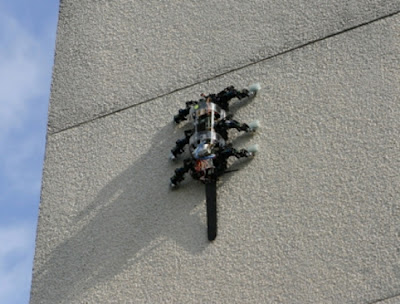
4. RiSE Climbing Robot


RiSE is a robot capable of climbing vertical terrain such as walls, trees and fences. It has “feet with micro-claws” to climb on textured surfaces. It weighs at 4.4 punds and is able to travel at 0.68 miles per hour.
It has six legs, an on-board computer that manages the coordination of these legs and a variety of sensors.

3. PetMan


This is a bipedal device constructed for testing chemical protection suits. The technology is basically derived from BigDog with advanced features such as sweating; simulating both human movement mechanics and human physiology to a much realistic extent.
PetMan is capable of walking on a treadmill i.e. walking, doing squats and pumping out push-ups. It also has a phased plasma rifle in the 40-watt range.
And as Boston Dynamics President Marc Raibert said:
“Places like the Fukushima reactors could be accessed by Petman-like robots (or AlphaDogs), without requiring any human exposure to hazardous materials. Perhaps firefighting inside of buildings or facilities designed for human access, like on board ships designed for human crews.”

2. Crusher


This 13,200-pound monster was developed by researchers at the Carnegie Mellon University’s National Robotics Engineering Center for DARPA. Its technical name is Unmanned Ground Combat Vehicle and Perceptor Integration System.
It can travel over walls as much as 4 feet high, wooded slopes and can even turn 180 degrees. It can also lower or raise its suspension by as much as 30 inches. Capable of seeing enemy troops from over 2 miles with its cameras, while carrying a maximum of 8,000 pounds of payload and armor combined, it is capable of moving at 26 miles per hour. The downside being, it can sustain that speed for 7 seconds only.

1. BigDog with Horns


And those horns would act as weapons, right? Of course, how long would a mechanized donkey last in a battlefield without weapons anyway? Then again, I don’t think horns are going to deflect bullets or something.

Facebook Buys Instagram for $1 Billion


Facebook is not waiting for its initial public offering to make its first big purchase.

In its largest acquisition to date, the social network has purchased Instagram, the popular photo-sharing application, for about $1 billion in cash and stock, the company said Monday.

It’s a notable move for Facebook, which has exclusively focused on bite-size acquisitions, worth less than $100 million.
With Instagram, Facebook will get a formidable mobile player – an area that is seen as a weakness for the sprawling social network. Founded two years ago, the service — which lets users share photos and apply stylized filters – has become one of the most downloaded applications on the iPhone, with some 30 million users. Instagram released a version of its application for Google’s Android operating system last week.

On Monday, both companies expressed their commitment to run Instagram as an independent service.

 In a post on his profile page, Facebook’s chief Mark Zuckerberg said Instagram would continue to work with rival social networks. That will allow users to post on other services, follow users outside of Facebook, and to opt out of sharing on Facebook.

“For years, we’ve focused on building the best experience for sharing photos with your friends and family,” Mr. Zuckerberg wrote. “Now, we’ll be able to work even more closely with the Instagram team to also offer the best experiences for sharing beautiful mobile photos with people based on your interests.”

In a separate blog post on Instagram’s Web site, the company’s chief executive, Kevin Systrom, also reiterated plans to preserve the service’s functionality and said he looked forward to leveraging the new parent company’s resources and talent.

The announcement comes as Facebook prepares for its highly anticipated initial public offering, widely expected to take place next month.

Though Facebook is known for smaller acquisitions, Instagram’s surging momentum likely compelled the social network to swiftly put together a billion-dollar offer. Last week, Instagram, which has just a handful of employees, closed a financing round worth more than $50 million with several prominent investors, including Sequoia Capital, an early backer of Google, Thrive Capital, the firm run by Joshua Kushner, and Greylock Capital, an early investor of LinkedIn. AllThingsD first reported last week that Sequoia was in the process of leading a $50 million round in Instagram.

That latest funding round valued Instagram at about $500 million, according to one person with knowledge of the matter, who requested anonymity because discussions were private. Facebook’s purchase, one week later, means that investment has now doubled in value.

The deal is expected to close later this quarter, according to Facebook’s statement.

Here is the news release from Facebook:

“Facebook announced today that it has reached an agreement to acquire Instagram, a fun, popular photo-sharing app for mobile devices.

“The total consideration for San Francisco-based Instagram is approximately $1 billion in a combination of cash and shares of Facebook. The transaction, which is subject to customary closing conditions, is expected to close later this quarter.”

Mark Zuckerberg, founder and chief executive of Facebook, posted about the transaction on his Facebook page:

“I’m excited to share the news that we’ve agreed to acquire Instagram and that their talented team will be joining Facebook.

“For years, we’ve focused on building the best experience for sharing photos with your friends and family. Now, we’ll be able to work even more closely with the Instagram team to also offer the best experiences for sharing beautiful mobile photos with people based on your interests.

“We believe these are different experiences that complement each other. But in order to do this well, we need to be mindful about keeping and building on Instagram’s strengths and features rather than just trying to integrate everything into Facebook.

“That’s why we’re committed to building and growing Instagram independently. Millions of people around the world love the Instagram app and the brand associated with it, and our goal is to help spread this app and brand to even more people.

“We think the fact that Instagram is connected to other services beyond Facebook is an important part of the experience. We plan on keeping features like the ability to post to other social networks, the ability to not share your Instagrams on Facebook if you want, and the ability to have followers and follow people separately from your friends on Facebook.

“These and many other features are important parts of the Instagram experience and we understand that. We will try to learn from Instagram’s experience to build similar features into our other products. At the same time, we will try to help Instagram continue to grow by using Facebook’s strong engineering team and infrastructure.

“This is an important milestone for Facebook because it’s the first time we’ve ever acquired a product and company with so many users. We don’t plan on doing many more of these, if any at all. But providing the best photo sharing experience is one reason why so many people love Facebook and we knew it would be worth bringing these two companies together.

“We’re looking forward to working with the Instagram team and to all of the great new experiences we’re going to be able to build together.”

Tuesday, April 10, 2012

Specialized Turbo E-Bike: Price and Release Date For Fastest Bicycle


The world’s largest bike manufacturer, Specialized, claims that it has created the world’s fastest electric bike. With the electric bike market already filled with exaggerated bike range and speed of other makers such as its rival Bike Trail, the company on the other hand is confident after the Turbo e-bike’s three years of development in its design and the engineering decision that goes with it. Probing further, one would definitely notice the Turbo e-bike’s ultra lightweight feature, thin and yet efficient tires, and a brilliant over-all finish.

Basically, it is what you may call as a pedal assist bike. This means that depending on how hard you pedal, there are cadence sensors that send signals to the bike’s controller which then adjusts the power to the motor. You can choose 3 levels of power assistance namely low, medium or high on the handle grip which is equipped with a wireless high tech gizmo. Such throttle-less interface gives you a bionic feeling every time you pedal that you may even have an illusion of being a super human while riding the bike.

Holding a track record of winning the world cup after creating Specialized’s 29er bike, Jan Talavasek, the e-bike’s lead engineer, believes that the e-bike definitely has a strong pedal bicycle roots. After all, every part of the e-bike is designed from scratch with its prototype built two years ago. It is a collaboration of Swiss engineers of the company’s Swiss division.

Custom features of the Specialized Turbo e-bike include:
  • 250W rear motor
  • top speed of 45 km/h
  • custom made frame
  • wireless throttle
  • custom dashboard / speedometer /battery meter
  • built in LED lights in front and back wired to e-bike battery
  • lightweight (47.5 pounds)
  • regenerative braking
  • 342Wh Li-ion customized battery unit (charges in 2 hours)


Bike-riding enthusiasts from Europe will have the chance to ride the Turbo e-bike at 50 selected retailers of Specialized in April. But the bike is scheduled to be sold in the stores not later than May. The cost is a staggering 5,500 Euros which is equivalent to $7,300. At present, there’s no information yet if the bike will be sold in the US as it has to deal first with the country’s speed limit issues.

Popular Posts Today

Followers

Twitter Delicious Facebook Digg Stumbleupon Favorites More