
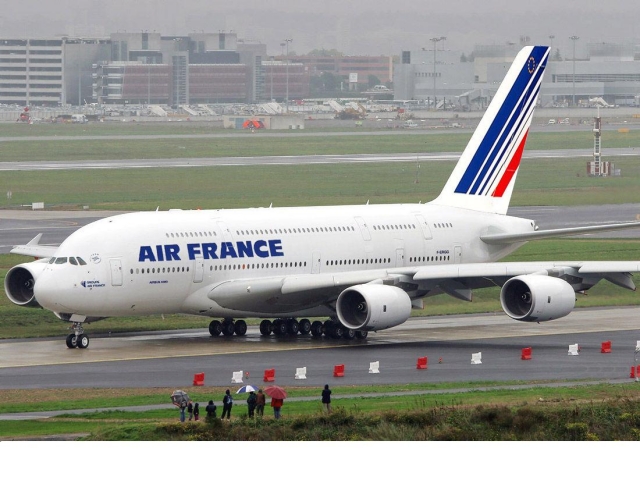
The Airbus
A380 is a double-deck, wide-body, four-engine jet airliner manufactured by the
European corporation Airbus, a subsidiary of EADS. It is the world's largest
passenger airliner and due to its size, many airports have had to expand their
facilities to properly accommodate it. Designed to challenge Boeing's monopoly
in the large-aircraft market, the A380 made its maiden flight on 27 April 2005
and entered initial commercial service in October 2007 with Singapore Airlines.
The aircraft was known as the Airbus A3XX during much of its development,
before receiving the A380 designation.
The A380's
upper deck extends along the entire length of the fuselage, with a width
equivalent to a wide-body aircraft. This allows for an A380-800's cabin with
478 square metres (5,145.1 sq ft) of floor space; 49% more floor space than the
next-largest airliner, the Boeing 747-400 with 321 square metres (3,455.2 sq
ft), and provides seating for 525 people in a typical three-class configuration
or up to 853 people in all-economy class configurations. The A380-800 has a
design range of 15,400 kilometres (8,300 nmi; 9,600 mi), sufficient to fly from
New York to Hong Kong, and a cruising speed of Mach 0.85 (about 900 km/h or 560
mph at cruising altitude).
As of
February 2012 there had been 253 firm orders for the A380, of which 72 have
been delivered.The largest order, for 90 aircraft, was from Emirates.
Development
Background
In the summer
of 1988, a group of Airbus engineers led by Jean Roeder began work in secret on
the development of an ultra-high-capacity airliner (UHCA), both to complete its
own range of products and to break the dominance that Boeing had enjoyed in
this market segment since the early 1970s with its 747. McDonnell Douglas
unsuccessfully offered its smaller, double-deck MD-12 concept for sale.Roeder
was given approval for further evaluations of the UHCA after a formal
presentation to the President and CEO in June 1990. The megaproject was
announced at the 1990 Farnborough Air Show, with the stated goal of 15% lower
operating costs than the 747-400.Airbus organised four teams of designers, one
from each of its partners (Aérospatiale, Deutsche Aerospace AG, British
Aerospace, CASA) to propose new technologies for its future aircraft designs.
The designs would be presented in 1992 and the most competitive designs would
be used.
In January
1993, Boeing and several companies in the Airbus consortium started a joint
feasibility study of an aircraft known as the Very Large Commercial Transport
(VLCT), aiming to form a partnership to share the limited market.This joint
study was abandoned two years later, Boeing's interest having declined because
analysts thought that such a product was unlikely to cover the projected $15
billion development cost. Despite the fact that only two airlines had expressed
public interest in purchasing such a plane, Airbus was already pursuing its own
large plane project. Analysts suggested that Boeing instead would pursue
stretching its 747 design, and that air travel was already moving away from the
hub and spoke system that consolidated traffic into large planes, and toward
more non-stop routes that could be served by smaller planes.
In June 1994
Airbus announced its plan to develop its own very large airliner, designated
the A3XX.Airbus considered several designs, including an odd side-by-side
combination of two fuselages from the A340, which was Airbus’ largest jet at
the time.The A3XX was pitted against the VLCT study and Boeing’s own New Large
Aircraft successor to the 747.From 1997 to 2000, as the East Asian financial
crisis darkened the market outlook, Airbus refined its design, targeting a
15–20% reduction in operating costs over the existing Boeing 747–400. The A3XX
design converged on a double-decker layout that provided more passenger volume
than a traditional single-deck design, in line with traditional hub-and-spoke
theory as opposed to the point-to-point theory of the Boeing 777,after
conducting an extensive market analysis with over 200 focus groups.
On 19
December 2000, the supervisory board of newly restructured Airbus voted to
launch an €8.8-billion programme to build the A3XX, re-christened as the A380,with
50 firm orders from six launch customers.The A380 designation was a break from
previous Airbus families, which had progressed sequentially from A300 to A340.
It was chosen because the number 8 resembles the double-deck cross section, and
is a lucky number in some Asian countries where the aircraft was being
marketed. The aircraft configuration was finalised in early 2001, and
manufacturing of the first A380 wing box component started on 23 January 2002.
The development cost of the A380 had grown to €11 billion when the first aircraft
was completed.
Production
Major
structural sections of the A380 are built in France, Germany, Spain, and the
United Kingdom. Due to their size, traditional transportation methods proved
unfeasible,so they are brought to the assembly hall (the Jean-Luc Lagardère
Plant) in Toulouse in France by specialized surface transportation, though some
parts are moved by the A300-600ST Beluga aircraft used in the construction of
other Airbus models.[27] A380 components are provided by suppliers from around
the world; the five largest contributors, by value, are Rolls-Royce, Safran,
United Technologies, General Electric and Goodrich.
For the
surface movement of large A380 structural components, a complex route known as
the Itinéraire à Grand Gabarit was developed. This involved the construction of
a fleet of roll-on/roll-off (RORO) ships and barges, the construction of port
facilities and the development of new and modified roads to accommodate
oversized road convoys.The front and rear fuselage sections are shipped on one
of three RORO ships from Hamburg in northern Germany to the United Kingdom.
The wings are
manufactured at Filton in Bristol and Broughton in North Wales, then
transported by barge to Mostyn docks, where the ship adds them to its cargo.In
Saint-Nazaire in western France, the ship trades the fuselage sections from
Hamburg for larger, assembled sections, some of which include the nose. The
ship unloads in Bordeaux. The ship then picks up the belly and tail sections
from Construcciones Aeronáuticas SA in Cádiz in southern Spain, and delivers
them to Bordeaux. From there, the A380 parts are transported by barge to
Langon, and by oversize road convoys to the assembly hall in Toulouse.The parts
are not handled directly.
After
assembly, the aircraft are flown to Hamburg Finkenwerder Airport (XFW) to be
furnished and painted. It takes 3,600 L (950 US gal) of paint to cover the
3,100 m2 (33,000 sq ft) exterior of an A380.Airbus sized the production
facilities and supply chain for a production rate of four A380s per month.
Testing
Five A380s
were built for testing and demonstration purposes.The first A380, serial number
MSN001 and registration F-WWOW, was unveiled in Toulouse 18 January 2005.[34]
Its maiden flight took place at 8:29 UTC (10:29 am local time) 27 April 2005.This
plane, equipped with Trent 900 engines, flew from Toulouse Blagnac
International Airport with a crew of six headed by chief test pilot Jacques
Rosay. After landing 3:54 hrs later, Rosay said flying the A380 had been “like
handling a bicycle”.
On 1 December
2005 the A380 achieved its maximum design speed of Mach 0.96, over its design
cruise speed of Mach 0.85, in a shallow dive, completing the opening of the
flight envelope.In 2006 the A380 flew its first high-altitude test at Bole
International Airport, Addis Ababa. It conducted its second high-altitude test
at the same airport in 2009.On 10 January 2006 it flew to José María Córdova
International Airport in Colombia, accomplishing the transatlantic testing, and
then it went to El Dorado International Airport to test the engine operation in
high-altitude airports. It arrived in North America on 6 February 2006, landing
in Iqaluit, Nunavut in Canada for cold-weather testing.
On 14
February 2006, during the destructive wing strength certification test on
MSN5000, the test wing of the A380 failed at 145% of the limit load, short of
the required 150% level. Airbus announced modifications adding 30 kg to the
wing to provide the required strength.On 26 March 2006 the A380 underwent
evacuation certification in Hamburg. With 8 of the 16 exits blocked, 853
passengers and 20 crew left the aircraft in 78 seconds, less than the 90
seconds required for certification.Three days later, the A380 received European
Aviation Safety Agency (EASA) and United States Federal Aviation Administration
(FAA) approval to carry up to 853 passengers.
The first
A380 using GP7200 engines—serial number MSN009 and registration F-WWEA—flew on
25 August 2006. On 4 September 2006 the first full passenger-carrying flight
test took place.[44] The aircraft flew from Toulouse with 474 Airbus employees
on board, in the first of a series of flights to test passenger facilities and
comfort.In November 2006 a further series of route-proving flights demonstrated
the aircraft's performance for 150 flight hours under typical airline operating
conditions.
Airbus
obtained type certificates for the A380-841 and A380-842 model from the EASA and
FAA on 12 December 2006 in a joint ceremony at the company's French headquarters.The
A380-861 model obtained its type certificate on 14 December 2007.
Production and delivery delays
Initial
production of the A380 was troubled by delays attributed to the 530 km (330 mi)
of wiring in each aircraft. Airbus cited as underlying causes the complexity of
the cabin wiring (100,000 wires and 40,300 connectors), its concurrent design
and production, the high degree of customisation for each airline, and failures
of configuration management and change control.The German and Spanish Airbus
facilities continued to use CATIA version 4, while British and French sites
migrated to version 5.This caused overall configuration management problems, at
least in part because wiring harnesses manufactured using aluminium rather than
copper conductors necessitated special design rules including non-standard
dimensions and bend radii; these were not easily transferred between versions
of the software.
Airbus
announced the first delay in June 2005 and notified airlines that deliveries
would be delayed by six months. This reduced the total number of planned
deliveries by the end of 2009 from about 120 to 90–100. On 13 June 2006 Airbus
announced a second delay, with the delivery schedule slipping an additional six
to seven months. Although the first delivery was still planned before the end
of 2006, deliveries in 2007 would drop to only 9 aircraft, and deliveries by the
end of 2009 would be cut to 70–80 aircraft. The announcement caused a 26% drop
in the share price of Airbus' parent, EADS,and led to the departure of EADS CEO
Noël Forgeard, Airbus CEO Gustav Humbert, and A380 programme manager Charles
Champion.On 3 October 2006, upon completion of a review of the A380 program,
Airbus CEO Christian Streiff announced a third delay,pushing the first delivery
to October 2007, to be followed by 13 deliveries in 2008, 25 in 2009, and the
full production rate of 45 aircraft per year in 2010.The delay also increased
the earnings shortfall projected by Airbus through 2010 to €4.8 billion.
As Airbus
prioritised the work on the A380-800 over the A380-800F,freighter orders were
cancelled by FedEx and UPS,or converted to A380-800 by Emirates and ILFC.Airbus
suspended work on the freighter version, but said it remained on offer,albeit
without a service entry date.For the passenger version Airbus negotiated a
revised delivery schedule and compensation with the 13 customers, all of which
retained their orders with some placing subsequent orders, including Emirates,
Singapore Airlines,Qantas,Air France,Qatar Airways, and Korean Air.
On 13 May
2008 Airbus announced reduced deliveries for the years 2008 (12) and 2009 (21).After
further manufacturing setbacks, Airbus announced its plan to deliver 14 A380s
in 2009, down from the previously revised target of 18.A total of 10 A380s were
delivered in 2009.In 2010 Airbus delivered only 18 of the expected 20 A380s,
due to Rolls-Royce engine availability problems.Airbus planned to deliver
"between 20 and 25" A380s in 2011 before ramping up to three a month
in 2012.In the event, Airbus delivered 26 units, thus outdoing its predicted
output for the first time.
Entry into service
Dubbed the
Superjumbo by the media the first aircraft, MSN003, (registered as 9V-SKA) was
delivered to Singapore Airlines on 15 October 2007 and entered service on 25
October 2007 with flight number SQ380 between Singapore and Sydney.Passengers
bought seats in a charity online auction paying between $560 and $100,380.Two
months later, Singapore Airlines CEO Chew Choong Seng stated the A380 was
performing better than both the airline and Airbus had anticipated, burning 20%
less fuel per passenger than the airline's 747–400 fleet.
Emirates was
the second airline to receive the A380 and commenced services between Dubai and
New York in August 2008.Qantas followed on 19 September 2008, starting flights
between Melbourne and Los Angeles in October 2008.By the end of 2008, 890,000
passengers had flown on 2,200 flights totalling 21,000 hours.
In February
2009 the one millionth passenger was flown with Singapore Airlinesand by May of
that year 1,500,000 passengers had flown on 4,200 flights totalling 41,000
hours.Air France received its first A380 in October 2009.Lufthansa received its
first A380 in May 2010.By July 2010, the 31 A380s then in service had
transported 6 million passengers on 17,000 flights totalling over 156,000 hours
between 20 international destinations.
Korean Air
was the sixth airline to receive the A380, initiating services in June 2011.By
June 2011 over 12 million passengers had flown on 33,000 flights totalling
almost 300,000 hours.China Southern Airlines was the seventh to operate the
aircraft, and the first to use it on scheduled routes in China, commencing
operation between Beijing, Guangzhou and Shanghai on 17 October 2011.[90] By
late October 2011, A380s had flown some 16 million passengers.As of 8 February
2012, 68 aircraft were in service.
During
repairs following the Qantas Flight 32 engine failure incident, cracks were
discovered in fittings within the wings. As a result of the discovery, EASA
issued an Airworthiness Directive in January 2011 affecting 20 A380 aircraft
that had accumulated over 1,300 hours flight. A380s with under 1,800 flight
hours were to be inspected within 6 weeks or 84 flights; aircraft with over
1,800 flight hours were to be examined within four days or 14 flights.Fittings
found to be cracked are being replaced following the inspections to maintain
structural integrity.On 8 February 2012, the checks were extended to cover all
68 A380 aircraft in operation. The problem is considered to be minor and is not
expected to affect operations.
Design

Overview

The A380 was
initially offered in two models. The A380-800 original configuration carried
555 passengers in a three-class configurationor 853 passengers (538 on the main
deck and 315 on the upper deck) in a single-class economy configuration. In May
2007 Airbus began marketing a configuration with 30 fewer passengers, (525
total in three classes), traded for 370 km (200 nmi) more range, to better
reflect trends in premium class accommodation. The design range for the −800
model is 15,400 km (8,300 nmi); capable of flying from Hong Kong to New York or
from Sydney to Istanbul non-stop. The second model, the A380-800F freighter,
would carry 150 tonnes of cargo 10,400 km (5,600 nmi).The −800F
development was put on hold as Airbus prioritised the passenger version and all
cargo orders were cancelled. Future variants may include an A380-900 stretch
seating about 656 passengers (or up to 960 passengers in an all economy configuration)
and an extended-range version with the same passenger capacity as the A380-800.
According to
TIME magazine:
The lack of engine noise—it's 50% quieter than a 747–400
on takeoff—was downright eerie. The A380 is so big it's difficult to sense its
speed, and its upper deck is so far away from the engines the noise dissipates.
—
The A380's
wing is sized for a maximum take-off weight (MTOW) over 650 tonnes in order to
accommodate these future versions, albeit with some strengthening required.The
stronger wing (and structure) would be used on the A380-800F freighter. This
common design approach sacrifices some fuel efficiency (due to a weight
penalty) on the A380-800 passenger model, but Airbus estimates that the size of
the aircraft, coupled with the advances in technology described below, will
provide lower operating costs per passenger than the 747-400 and older 747
variants. The A380 also features wingtip fences similar to those found on the
A310 and A320 to reduce induced drag, increasing fuel efficiency and
performance.
Engines

The A380 is
available with two types of turbofan engines, the Rolls-Royce Trent 900
(variants A380-841, −842 and −843F) or the Engine Alliance GP7000 (A380-861 and
−863F). The Trent 900 is a derivative of the Trent 800, and the GP7000 has
roots from the GE90 and PW4000. The Trent 900 core is a scaled version of the
Trent 500, but incorporates the swept fan technology of the stillborn Trent
8104.The GP7200 has a GE90-derived core and PW4090-derived fan and
low-pressure turbo-machinery.Noise reduction was an important requirement
in the A380 design, and particularly affects engine design.Both engine types
allow the aircraft to achieve QC/2 departure and QC/0.5 arrival noise limits
under the Quota Count system set by London Heathrow Airport,which is a key
destination for the A380.
The A380 was
initially planned without thrust reversers, incorporating sufficient braking capacity
to do without them.However Airbus elected to equip the two inboard engines with
thrust reversers in a late stage of development.The two outboard engines do not
have reversers, reducing the amount of debris stirred up during landing. The
A380 has electrically actuated thrust reversers, giving them better reliability
than their pneumatic or hydraulic equivalents, in addition to saving weight.
The A380 was
used to demonstrate the viability of a synthetic fuel comprising standard jet
fuel with a natural-gas-derived component. On 1 February 2008, a three-hour
test flight operated between Britain and France, with one of the A380's four
engines using a mix of 60% standard jet kerosene and 40% gas to liquids (GTL)
fuel supplied by Shell.The aircraft needed no modification to use the GTL fuel,
which was designed to be mixed with normal jet fuel. Sebastien Remy, head of
Airbus SAS's alternative fuel programme, said the GTL used was no cleaner in
CO2 terms than standard fuel but it had local air quality benefits because the
GTL portion contains no sulphur.
Advanced materials
While most of
the fuselage is aluminium, composite materials comprise more than 20% of the
A380's airframe.Carbon-fibre reinforced plastic, glass-fibre reinforced plastic
and quartz-fibre reinforced plastic are used extensively in wings, fuselage
sections (such as the undercarriage and rear end of fuselage), tail surfaces,
and doors. The A380 is the first commercial airliner to have a central wing box
made of carbon fibre reinforced plastic. It is also the first to have a
smoothly contoured wing cross section. The wings of other commercial airliners
are partitioned span-wise into sections. This flowing, continuous cross section
optimises aerodynamic efficiency. Thermoplastics are used in the leading edges
of the slats.The composite material GLARE (GLAss-REinforced fibre metal
laminate) is used in the upper fuselage and on the stabilisers' leading edges.This
aluminium-glass-fibre laminate is lighter and has better corrosion and impact
resistance than conventional aluminium alloys used in aviation.Unlike earlier
composite materials, GLARE can be repaired using conventional aluminium repair
techniques.Newer weldable aluminium alloys are also used. This enables the
widespread use of laser beam welding manufacturing techniques, eliminating rows
of rivets and resulting in a lighter, stronger structure.
Avionics
The A380
employs an Integrated Modular Avionics (IMA) architecture, first used in
advanced military aircraft, such as the F-22 Raptor, F-35 Lightning II,and
Dassault Rafale.The main IMA systems on the A380 were developed by the Thales
Group.Designed and developed by Airbus, Thales and Diehl Aerospace, the IMA
suite was first used on the A380. The suite is a technological innovation, with
networked computing modules to support different applications.The data
communication networks use Avionics Full-Duplex Switched Ethernet, an
implementation of ARINC 664. The data networks are switched, full-duplex,
star-topology and based on 100baseTX fast-Ethernet.This reduces the amount of
wiring required and minimises latency.
Airbus used
similar cockpit layout, procedures and handling characteristics to other Airbus
aircraft, reducing crew training costs. The A380 has an improved glass cockpit,
using fly-by-wire flight controls linked to side-sticks.The cockpit displays
feature eight 15-by-20 cm (5.9-by-7.9 in) liquid crystal displays, all physically
identical and interchangeable; comprising two Primary Flight Displays, two
navigation displays, one engine parameter display, one system display and two
Multi-Function Displays. The MFDs were introduced on the A380 to provide an
easy-to-use interface to the flight management system—replacing three multifunction
control and display units. They include QWERTY keyboards and trackballs,
interfacing with a graphical "point-and-click" display system.
The Network
Systems Server (NSS) is the heart of A380's paperless cockpit; it eliminates
bulky manuals and charts traditionally used.The NSS has enough inbuilt
robustness to eliminate onboard backup paper documents. The A380's network and
server system stores data and offers electronic documentation, providing a
required equipment list, navigation charts, performance calculations, and an
aircraft logbook. This is accessed through the MFDs and controlled via the
keyboard interface.
Power-by-wire
flight control actuators have been used for the first time in civil aviation to
back up primary hydraulic actuators. Also, during certain manoeuvres they augment
the primary actuators.They have self-contained hydraulic and electrical power
supplies. Electro-hydrostatic actuators (EHA) are used in the aileron and
elevator, electric and hydraulic motors to drive the slats as well as
electrical backup hydrostatic actuators (EBHA) for the rudder and some spoilers.
The A-380's
350 bar (35 MPa or 5,000 psi) hydraulic system is a significant difference from
the typical 210 bar (21 MPa or 3,000 psi) hydraulics used on most commercial
aircraft since the 1940s. First used in military aircraft, high-pressure
hydraulics reduce the weight and size of pipelines, actuators and related
components. The 350 bar pressure is generated by eight de-clutchable hydraulic
pumps.The hydraulic lines are typically made from titanium; the system features
both fuel- and air-cooled heat exchangers. Self-contained electrically powered
hydraulic power packs serve as backups for the primary systems, instead of a
secondary hydraulic system, saving weight and reducing maintenance.
The A380 uses
four 150 kVA variable-frequency electrical generators,eliminating constant-speed
drives and improving reliability.The A380 uses aluminium power cables instead
of copper for weight reduction. The electrical power system is fully
computerised and many contactors and breakers have been replaced by solid-state
devices for better performance and increased reliability.
Passenger provisions
The cabin has
features to reduce traveller fatigue such as a quieter interior and higher
pressurisation than previous aircraft; the A380 has 50% less cabin noise than
the 747-400 and is pressurised to the equivalent of 1,520 m (5,000 ft) altitude
versus 2,440 m (8,000 ft) on the 747-400.The A380 has 50% more cabin area and
volume, larger windows, bigger overhead bins, and 60 cm (2.0 ft) extra headroom
versus the 747-400.Seating options range from 4-abreast in first class to
11-across in economy.On other aircraft, economy seats range from 41.5 cm (16.3
in) to 52.3 cm (20.6 in) in width,A380 economy seats are up to 48 cm (19 in)
wide in a 10-abreast configuration; compared with the 10-abreast configuration
on the 747-400 which typically has seats 44.5 cm (17.5 in) wide.
The A380's
upper and lower decks are connected by two stairways, fore and aft, wide enough
to accommodate two passengers side-by-side; this cabin arrangement allows
multiple seat configurations. The maximum certified carrying capacity is 853
passengers in an all-economy-class layout,Airbus lists the typical three-class
layout as accommodating 525 passengers, with 10 first, 76 business, and 439 economy
class seats.Airline configurations range from Korean Air's 407 passengers to
Air Austral's 840 passengers.The A380's interior illumination system uses
bulbless LEDs in the cabin, cockpit, and cargo decks. The LEDs in the cabin can
be altered to create an ambience simulating daylight, night, or intermediate
levels.On the outside of the aircraft, HID lighting is used for brighter
illumination.
Airbus'
publicity has stressed the comfort and space of the A380 cabin,and advertised
onboard relaxation areas such as bars, beauty salons, duty-free shops, and
restaurants.Proposed amenities resembled those installed on earlier airliners,
particularly 1970s wide-body jets,which largely gave way to regular seats for
more passenger capacity.Airbus has acknowledged that some cabin proposals were
unlikely to be installed,and that it was ultimately the airlines' decision how to
configure the interior.Industry analysts suggested that implementing customisation
has slowed the production speeds, and raised costs.Due to delivery delays,
Singapore Airlines and Air France debuted their seat designs on different aircraft
prior to the A380.
Initial
operators typically configured their A380s for three-class service, while
adding extra features for passengers in premium cabins. Launch customer
Singapore Airlines debuted partly enclosed first class suites on its A380s in
2007, each featuring a leather seat with a separate bed; center suites could be
joined to create a double bed.A year later, Qantas debuted a new first class
seat-bed and a sofa lounge at the front of the upper deck on its A380s. In late
2008, Emirates introduced "shower spas" in first class on its A380s,along
with a bar lounge and seating area on the upper deck,and in 2009 Air France
unveiled an upper deck electronic art gallery.In addition to lounge areas, some
A380 operators have installed amenities consistent with other aircraft in their
respective fleets, including self-serve snack bars,premium economy sections,and
redesigned business class seating.
Integration with infrastructure and regulations
Ground operations
In the 1990s,
aircraft manufacturers were planning to introduce larger planes than the Boeing
747. In a common effort of the International Civil Aviation Organization, ICAO,
with manufacturers, airports and its member agencies, the "80-metre
box" was created, the airport gates allowing planes up to 80 m (260 ft)
wingspan and length to be accommodated.Airbus designed the A380 according to
these guidelines,and to operate safely on Group V runways and taxiways, and
while the U.S. FAA opposed this at an early stage, in July 2007, the FAA and
EASA agreed to let the A380 operate on 45 m runways without restrictions.The
A380-800 is approximately 30% larger in overall size than the 747-400,and can
land or take off on any runway that can accommodate a 747. Runway lighting and
signage may need changes to provide clearance to the wings and avoid blast
damage from the engines and taxiway shoulders may be required to be stabilised
to reduce the likelihood of foreign object damage caused to (or by) the
outboard engines, which overhang more than 25 m (82 ft) from the centre line of
the aircraft.
Airbus
measured pavement loads using a 540-tonne (595 short tons) ballasted test rig,
designed to replicate the landing gear of the A380. The rig was towed over a
section of pavement at Airbus' facilities that had been instrumented with
embedded load sensors. It was determined that the pavement of most runways will
not need to be reinforced despite the higher weight,as it is distributed on
more wheels than in other passenger aircraft with a total of 22 wheels.The A380
undercarriage consists of four main landing gear legs and one noseleg (a
similar layout to the 747), with the two inboard landing gear legs each
supporting six wheels.
The A380
requires service vehicles with lifts capable of reaching the upper deck,as well
as tractors capable of handling the A380's maximum ramp weight.Using two jetway
bridges the boarding time is 45 min, using an extra jetway to the upper deck it
is reduced to 34 min.The A380 test aircraft have participated in a campaign of
airport compatibility testing to verify the modifications already made at
several large airports, visiting a number of airports around the world.
Takeoff and landing separation
In 2005, the
ICAO recommended that provisional separation criteria for the A380 on takeoff
and landing be substantially greater than for the 747 because preliminary
flight test data suggested a stronger wake turbulence.These criteria were in
effect while the ICAO's wake vortex steering group, with representatives from
the JAA, Eurocontrol, the FAA, and Airbus, refined its 3-year study of the
issue with additional flight testing. In September 2006, the working group
presented its first conclusions to the ICAO.
In November
2006, the ICAO issued new interim recommendations. Replacing a blanket 10
nautical miles (19 km) separation for aircraft trailing an A380 during
approach, the new distances were 6 nmi (11 km), 8 nmi (15 km) and 10 nmi (19
km) respectively for non-A380 "Heavy", "Medium", and
"Light" ICAO aircraft categories. These compared with the 4 nmi (7.4
km), 5 nmi (9.3 km) and 6 nmi (11 km) spacing applicable to other
"Heavy" aircraft. Another A380 following an A380 should maintain a
separation of 4 nmi (7.4 km). On departure behind an A380, non-A380
"Heavy" aircraft are required to wait two minutes, and
"Medium"/"Light" aircraft three minutes for time based
operations. The ICAO also recommends that pilots append the term
"Super" to the aircraft's callsign when initiating communication with
air traffic control, in order to distinguish the A380 from "Heavy"
aircraft.
In August
2008, the ICAO issued revised approach separations of 4 nmi (7.4 km) for Super
(another A380), 6 nmi (11 km) for Heavy, 7 nmi (13 km) for medium/small, and 8
nmi (15 km) for light.
Future variants
Improved A380-800
From 2013,
Airbus will introduce a new A380 build standard incorporating a strengthened
airframe structure and a 1.5° increase in wing twist. Airbus will also offer,
as an option, an improved maximum take-off weight, thus providing a better
payload/range performance. Maximum take-off weight is increased by 4 t (8,800
lb), to 573 t (1,260,000 lb) and an additional 190 km (100 nmi) in range. This
is achieved by reducing flight loads, partly from optimising the fly-by-wire
control laws.British Airways and Emirates will be the first customers to
receive this new option.Vietnam Airlines has shown interest in the
higher-weight variant.
A380-900

In November
2007, Airbus top sales executive and chief operating officer John Leahy
confirmed plans for an enlarged variant, the A380-900, which would be slightly
longer than the A380-800 (79.4–73 m or 260–240 ft).This version would have a
seating capacity of 650 passengers in standard configuration, and approximately
900 passengers in economy-only configuration. In May 2010, Airbus announced
that A380-900 development was postponed, until production of the A380-800 has
stabilised.Airlines that have expressed interest in the model include
Emirates, Virgin Atlantic,Cathay Pacific,Air France-KLM, Lufthansa, Kingfisher
Airlines,as well as the leasing company ILFC.
A380-800 freighter
Airbus
originally accepted orders for the freighter version, offering the second
largest payload capacity of any cargo aircraft, exceeded only by the Antonov
An-225.However, production has been suspended until the A380 production lines
have settled with no firm availability date.
Market
In 2006,
industry analysts Philip Lawrence of the Aerospace Research Centre in Bristol
and Richard Aboulafia of the consulting Teal Group in Fairfax anticipated 880
and 400 A380 sales respectively by 2025.According to Lawrence, parallel to the
design of the A380, Airbus conducted the most extensive and thorough market
analysis of commercial aviation ever undertaken, justifying its VLA (very large
aircraft, those with more than 400 seats) plans,while according to Aboulafia,
the rise of mid-size aircraft and market fragmentation reduced VLAs to niche
market status, making such plans unjustified.The two analysts' market forecasts
differed in the incorporation of spoke-hub and point-to-point models.
In 2007,
Airbus estimated a demand for 1,283 passenger planes in the VLA category for
the next 20 years if airport congestion remains at the current level. According
to this estimate, demand could reach up to 1,771 VLAs if congestion increases.
Most of this demand will be due to the urbanisation and rapid economic growth
in Asia. The A380 will be used on relatively few routes, between the most
saturated airports. Airbus also estimates a demand for 415 freighters in the
category 120-tonne plus. Boeing, which offers the only competition in that
class, the 747-8, estimates the demand for passenger VLAs at 590 and that for
freighter VLAs at 370 for the period 2007–2026.
At one time
the A380 was considered as a potential replacement for the existing Boeing
VC-25 serving as Air Force One,but in January 2009 EADS declared
that they were not going to bid for the contract, as assembling only three
planes in the US would not make financial sense.
The
break-even for the A380 was initially supposed to be reached by selling 270
units, but due to the delays and the falling exchange rate of the US dollar, it
increased to 420 units.In 2010, EADS CFO Hans Peter Ring said that break-even
(on the aircraft that are delivered) could be achieved by 2015, despite the
delays; there should be around 200 deliveries by that time, on current
projections.As of March 2010 the average list price of an A380 was US$ 375.3
million (about €261 million or £229 million), depending on equipment installed.


